
Contactless painting scanning
The usual materials to be scanned are tangible, there is a target machine for them, and thus their saving can be done quickly and cheaply. However, there are images that cannot be saved with a flatbed scanner due to their size or vulnerability.
Typically, these are paintings, old documents, maps, large graphics, reliefs, copper engravings, embroideries, tapestries, which would still be good to preserve and reproduce for posterity. :)
There is a target machine for this case too, and this is the CRUSE painting scanner.
What is the difficulty in photographing these objects?
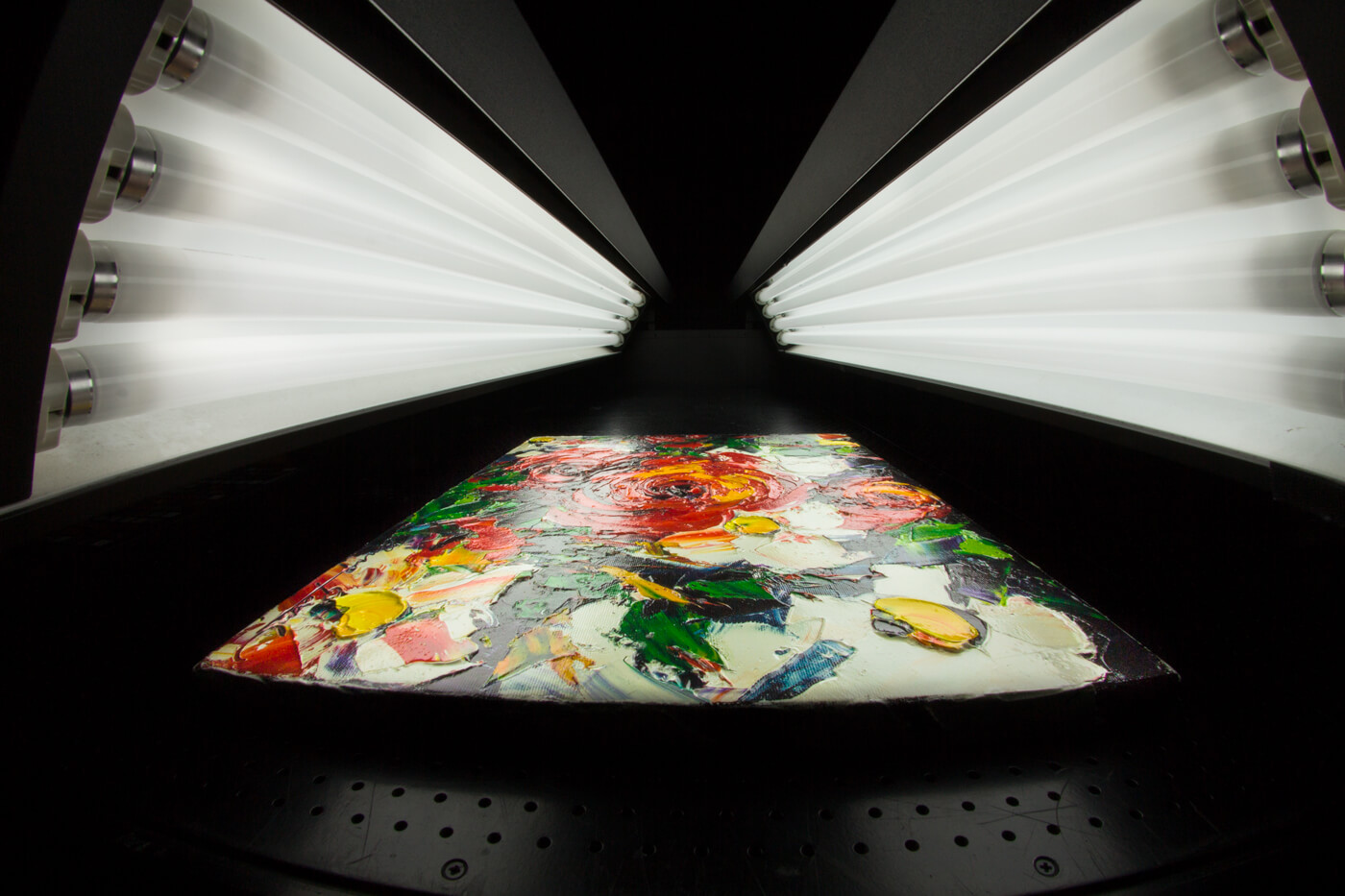
Primarily their vulnerability and the fact that paintings are framed and have uneven surfaces due to the layers of paint built on top of each other.
So the solution arises, then let's not scan, but photograph these objects.
And here comes the other serious problem:
the light.
Special, homogeneous lights must be created for photography. Another problem is the reflection of oil paints, which must be filtered out of the image, and the photographer also struggles with color accuracy.
Lenses vignette in every case, meaning the digital image darkens and blurs towards the edges. In contrast, CRUSE is a line scanner that sees a strip of the image at a time and moves the object table under the optics.
Photography unfortunately involves compromises. The thickness and plasticity of paint layers are very difficult to capture in a photo, requiring huge professional routine, or unfortunately meaning significant compromise. In addition, the resolution of digital cameras or backs limits the scalability of reproductions.
It is clearly visible that photography, besides being equipment and cost-intensive, does not necessarily serve the client's needs.
So what is the solution after all?
The aforementioned special giant scanner, the CRUSE, which the designers dreamed up specifically for this task. With this tool, the works of immortal painters, graphic artists, or even sculptors can be preserved in digital form. Moreover, not only can they be preserved with it, but they can even become printable again, in lifelike, photo quality.
Here is where the CRUSE painting scanner really excels:
- It is capable of scanning paintings up to 100x150cm in size, even at such high resolution that the painting will be printable in photo quality even when enlarged multiple times.
- The final file size can be up to 14200 x 55000 pixels, into an 8-bit uncompressed TIFF file.
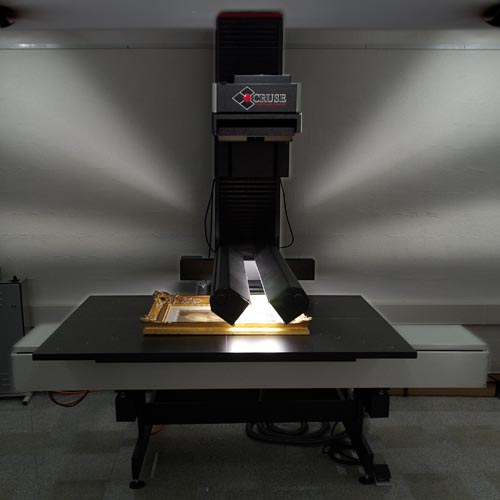
- The picture does not need to be removed from its frame, and we can scan through glass as well.
- The machine works with homogeneous neutral white lighting on the entire surface; there will be no shadows on the scanned image due to waviness.
- The image file will be precise and color-accurate.
It is a perfect solution for scanning framed paintings, graphics, portraits glued to wood panels, maps, for those to whom quality is important. The saved image will be absolutely color-accurate, and the original cannot be damaged either, as there is no need to physically touch the pictures, and the light used does not damage priceless artworks.
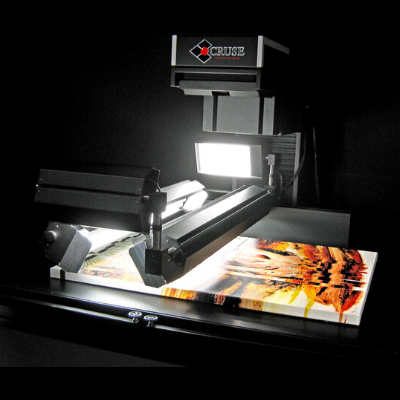
CRUSE in action:
Who do we recommend scanning with the CRUSE scanner for?
Primarily for museums, art collectors, and those who possess real treasures from family heritage that they want to preserve digitally or print in photo quality.
How much does painting scanning and using the CRUSE scanner cost?
Scanning large framed or wavy images (painting, map, artwork, etc.):
| Size | Price |
|---|---|
| Within 50×100 cm size | 20 499 Ft |
| Within 100×100 cm size | 40 499 Ft |
| Within 150×100 cm size | 70 499 Ft |
You can drop off items to be digitized for painting scanning at our shop (1065 Budapest, Bajcsy-Zs. út 63.), or send them by courier to our central address: 1141 Budapest, Cinkotai út 12.
Find our opening hours here!
Our contracted partner, GLS, goes to your home for your memories!
